
Cash Cow: How the Maternal Body Became a Global Commodity–and the Hidden Costs for Women by Alev Scott, Harper Collins, February 26, 2026
by Jo Ann Zimmerman
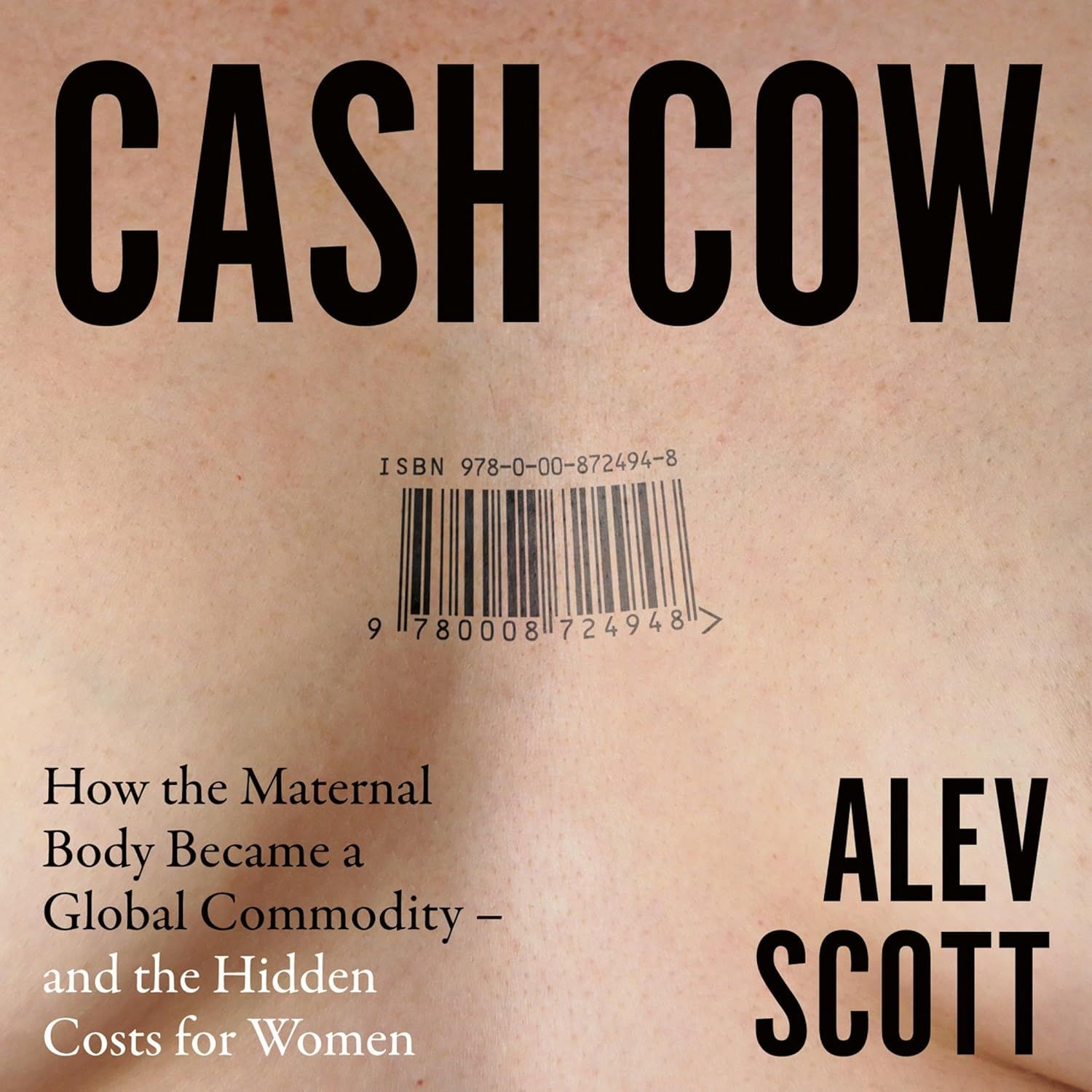
A growing number of American parents are facing a familiar challenge in a way their own parents likely never imagined—answering their children’s questions about where babies come from. As awkward as yesteryear’s conversations that began, “Well, when two people love each other very much…” may have been, today’s answer might very well be “Ukraine.” Or “a test tube.”
As Alev Scoot reveals in her new book Cash Cow: How the Maternal Body Became a Global Commodity – and the Hidden Costs for Women, baby-making, from eggs and embryos to IVF and surrogacy, "has become a capitalist’s wet dream.” Fueled by falling fertility rates—worldwide, one in six couples struggle to conceive--and funded by private equity, the global fertility industry is projected to net $70.27 billion dollars by 2030. The surrogacy market, valued at $27.9 billion in 2025, will reach more than $200 billion in 2034 at current growth rates.
Part memoir and part journalistic expose, the book follows the author’s journey into the fertility fire, beginning in the Covid lockdown period. She found herself with a newborn for whom she pumped breast milk and ended up with much more than her own baby could use. Initially she donated the frozen excess to a milk bank at her local hospital, where it was used to feed premature infants. While searching online for other outlets, she stumbled upon a site called Only the Breast that sold breast milk for $50-$60 per gallon. Curious to learn about the for-profit human milk market, she poses as a seller, only to discover that the site’s prime customers are not other mothers but men. Some claim to need colostrum, a thick yellow component of breast milk, that health gurus claim improves gut health and athletic performance; most turned out to be “erotic lactators” with a fetish for being wet-nursed. Ewww.
Things only get more unsavory from there when the fertility struggles of some close friends in the UK lead Scott into the surreal world of “donor eggs” and IVF. Despite the word donor, human eggs are not free, not even to the women who make them for their own use later. And the process is grueling. On the second or third day of their menstrual cycle, donors begin daily injections to stimulate far more eggs than are made in a normal month. Donors are then monitored every 2-3 days with blood tests and ultrasounds until the eggs are harvested under general anesthesia 10 days after the injection of a hormone to help the eggs mature. A good outcome will produce 12-15 useable eggs, but there are no guarantees.
Many women endure 3 or 4 or even more rounds of this physical and emotional ordeal in pursuit of parenthood. Scott’s friend said, “she felt lucky that she got away with a mere six months of hormonal imbalance and sleep disruption after her egg retrieval.” All for the bargain price of 8475 pounds ($11,409). Per. Round. And that doesn’t include around $1100 a year for egg storage.
Women forced to procure eggs from other women can paradoxically pay less, depending on where they live, where the eggs come from, and who the eggs come from. Posing at times as a buyer or seller of eggs in Northern Cyprus, the current international center of the fertility industry, the author finds no fewer than 17 IVF clinics in the city of Lefkasa (population 100,000). Clinics there charge 1/3 of what clients pay in the UK for donor eggs, which mostly come from Cypriot college students who sell their eggs to cover basic living expenses. For a premium of $450-$900, buyers can get eggs from blond haired blue-eyed Russian or Ukrainian women, adding eugenicist concerns to those of exploitation and human organ trafficking.
And then there’s surrogacy. In most of Europe, surrogacy is illegal, and in much of the remaining developed world, is strictly regulated. Meanwhile, the U.S. has been steadily expanding access to surrogacy, In fact, the U.S. has always been the biggest market for commercial surrogacy in the world--for those who can afford it. As of 2025, the cost to procure a single surrogate child ran as high as $250,000.
In the U.S., the Midwest in general and Idaho specifically are surrogacy hotspots. Perhaps that is because until 2023, there were no surrogacy regulations at all in Idaho, and the ones implemented then are inconsequential. According to one surrogate the author spoke with, "There is still not enough supply to meet demand for surrogacy in Boise, even though 50% of the pregnant women where she lives, a town of 1200 just outside Boise, are surrogates.” For carrying and delivering one child, a surrogate there earns $50,000, higher than the state’s average income. Cost conscious parents-to-be can instead choose to find a surrogate in nearby Mexico, where women are paid around $16,000 per child, 25% higher than the country’s average income.
All of these numbers reveal serious inequalities that the fertility industry openly uses to maximize their monetary returns. To illustrate, Scott shares a conversation with a prominent fertility doctor in California. When the author suggested the system was exploiting women throughout the baby-making process, the doctor took issue with her characterization. He insisted the industry did not exploit participants, but rather took advantage of imbalances between the supply of and demand for a product, which he seemed to regard as just good business practice.
While the author at times acknowledges the ethical gray areas surrounding fertility services, at the end of the day, she comes down in favor of the U.S. model of allowing free markets to manage the buying and selling of mothers’ bodies and their parts. Yet her position that bans only serve to drive the fertility industry underground rings somewhat hollow given the market already exploits low-income women, using them as literal cash cows to pad private equity bottom lines. And considering the nature of baby markets, it’s hard not to compare them to human trafficking, a practice no one is calling to legalize. In light of the obvious parallels, perhaps it’s time to reconsider how we think about the fertility industry.
Jo Ann Zimmerman is a lifelong educator and writer living in Philadelphia. Most recently a member of the faculty at the University of the Arts, she shares her home with an amazing husband and an indifferent cat. Her work has appeared in Cleaver Magazine, The Sportscribe, Literary Heist, and other publications.
Subscribe to my newsletter
Subscribe to my newsletter to get the latest updates and news






Member discussion