
Dark Side of the Boom: How Scammers Hijacked the AI Revolution by Patrick Coughlin, River Grove Books, June 23, 2026
by Jo Ann Zimmerman
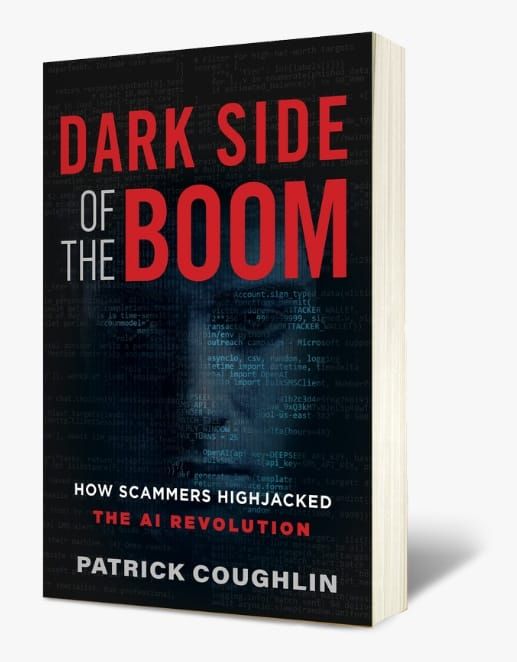
Whatever opinions you have about the impact of AI on employment, critical thinking, creativity, and oh I don’t know, EVERYTHING, there is one effect of the AI takeover that is little discussed—its power to propagate fraud. Mention scamming to anyone who grew up in the internet age and they’re likely to think of Nigerian princes or the crazy frog ringtone. But fraud is at least as old as the book of Genesis, where a serpent scams Eve into eating an apple from the tree of knowledge.
Of course, today’s scams are much more sophisticated. And successful. Patrick Coughlin’s new book Dark Side of the Boom: How Scammers Hijacked the AI Revolution reveals that digital fraud is now the fastest-growing crime in the United States; from 2023-2025, consumer scam losses grew by 60%. Globally, the cost of digital fraud will reach more than $5 trillion by 2030, more than the current GDP of Switzerland. And scams are as widespread as they are costly; 1 in 4 Americans were victims of digital fraud in 2025.
If you’re thinking “Oh, I’d never fall for one of those cheesy tricks,” consider that one of those victims was the author of this book. When a cybersecurity expert writing a book on, well, cybersecurity, tells you he was “ one click away from giving access to his iCloud account” to an Apple Customer Support scammer, you know there’s a problem.
Early on, the author spends a lot of time explaining what he calls the six archetypes of internet fraud, along with the five families of fraud, as background to understand the scam examples presented in his book. More important is the role of artificial intelligence in triggering the skyrocketing success of today’s scammers as compared with Nigerian princes. Here his analysis is spot on, detailing how AI helps bad actors harvest huge volumes of victims’ data, including their full names, addresses past and present, email, phone numbers, date of birth, employment history, bank names, credit history, and social security numbers. This data is bundled and sold to scammers on dark markets for $1000-$5000 per 100,000 profiles, or around 1-5 cents each. AI is then used to generate believable personas that are matched with the perfect target profiles and the scams play out, millions of times a day globally.
During the Covid pandemic, for example, scam texters and callers targeted senior citizens by posing as Medicare agents offering free tests and treatment, coercing victims to surrender their medical information. The scammers then used that data to create false claims and collect large sums from insurance companies. Given today’s political climate, scammers now target profiles with foreign sounding names by impersonating immigration officials and threatening victims with deportation unless they pay “outstanding fines.” Along the way, scammers follow scripts AI generates for each profile, sending victims to local banks and fake web sites with trusted names.
There are many more types of scams, of course, and all are supercharged by AI. Deepfakes, for example, are proliferating at a precipitous pace as the LLMs that power generative AI continue to improve and the cost to produce synthetic content drops by the day. Beyond fake celebrity videos, today’s technology allows scammers to build entirely synthetic identities that combine real and fictitious data from stolen medical records, personal profiles, and financial information. These “frankendentities” then apply for credit cards, gamble on gaming platforms, and use “buy now pay later” checkout at online retailers to steal high ticket merchandise.
At this point, you’re probably wondering how the hell we let these things happen. Dr. Amos Wilson sums it up nicely: “If you want to understand any problem in America, you need to look at who profits from that problem, not at who suffers from that problem.” In this case, those profiting are the billionaire tech bros of Meta, Google, and Microsoft, along with the developers of AI itself (ChatGPT, Anthropic, etc.). These platform profiteers have created unimaginable wealth for themselves while stealing from and preying upon the public.
The numbers are mind numbing. When OpenAI launched ChatGPT in 2022, it grew 20 times faster than Facebook, hitting 100 million users in just two months. Meanwhile, GPU chipmaker Nvidia grew so quickly after the launch of ChatGPT that 80% of their 30,000 employees became millionaires. And The Washington Post has reported that the amount invested in AI in the U.S. since mid-2022 will soon exceed all prior investments in the entire tech industry. It is hardly surprising, then, that top tech companies oppose regulation of the AI market to protect their windfalls.
Fortunately, Dark Side of the Boom is not a postmortem as so many such analyses of corporate wrongdoing end up being. Coughlin does not throw up his hands in despair or make a lame call for “serious discussion of how to move forward.” In what turns out to be the strongest section of the book, Fighting Back, he instead provides examples of best practices that are working now as well as some that could be implemented with good results.
While the U.S. drags its feet developing the necessary guardrails for AI, the European Union has crafted the global gold standard of AI regulation—Article 50 of the EU AI Act. The Act, which will take effect on August 2, 2026, “requires labeling of all AI generated content within the EU, including images, video, text, and audio” via watermarks and other technological methods. Critically, providers who fail to comply with these mandates face substantial penalties—up to 1.5 million euros or 3% of annual revenue—for each offense. Because money talks.
That’s why even though American government has little appetite for similar legislation to reign in AI abuses, individual American businesses whose reputations are harmed when scammers victimize their customers are taking action. Robinhood, the consumer securities trading platform, grew tired of being a popular target for scammers. In 2025, their security team discovered that thousands of Robinhood users were receiving text messages claiming the company had found unusual activity on their customer accounts, followed by phone calls from scammers posing as “fraud protection agents” who needed their login information to secure/drain their accounts.
In November of that year, Robinhood released a simple but effective fix. Users who opened the Robinhood app while on a phone call saw a banner pop up on their screens that read “We’re not calling you.” This type of tech integration shows how financial product companies can take more responsibility to protect users from common digital fraud scenarios.
While the cost to consumers of the American government’s refusal to enact policies, programs, and most important, penalties for corporate bad actors who fail to protect the public from AI generated scams is obviously high, the stakes can be even higher. In 2023, Slovakia became the first nation whose elections were likely decided by a deepfake. Two days before the voting began, an AI-generated audio clip spread online that seemed to record the liberal candidate talking with a journalist about a plot to rig the election. Because Slovakian law imposes a political media blackout for 48 hours before an election, the Progressive party had no way to counter the fake conversation. As a direct result, the Progressive candidate dropped from a clear frontrunner to second place, allowing the pro-Russian populist to win the most votes.
Clearly, the U.S. needs effective regulation of AI technology before failing to control its abuses costs us more than cash. Because there is no dark side of the boom really. As a matter of fact, it is all dark.
Jo Ann Zimmerman is a lifelong educator and writer living in Philadelphia. Most recently a member of the faculty at the University of the Arts, she shares her home with an amazing husband and an indifferent cat. Her work has appeared in Cleaver Magazine, The Sportscribe, Literary Heist, and other publications.
Subscribe to my newsletter
Subscribe to my newsletter to get the latest updates and news





Member discussion