
Mantras of the Moon by Srijani Mitra, University of Alabama Press (May 2026)
A review by Aryaa Anand
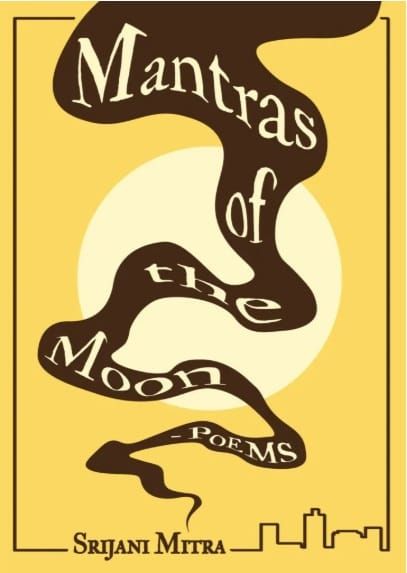
Srijani Mitra's Mantras of the Moon
A Divine Reflection of the Inner Feminine
Mantras of the Moon by Srijani Mitra is a classic amalgamation of literary sensibility, spirituality and psychology. The poet brings out wonderful cityscapes, reconstructs myths from around the world tying them to the realities of contemporary scenarios, dwells on Indian poetics and aesthetics—all while keeping the essence of poetry and literature alive throughout her work.
Memory and Longing
“Sprinkling like light dust, opaque, yet translucent enough
To cut and fold and arrive unexpectedly as flashbulbs.”
In ‘Monsoon of Memories’, Mitra poignantly represents how memories show up on random days, appearing not altogether, but creeping in through doors and windows like light dust and taking some time to settle down. While we, as humans, are engrossed in the conflict of letting them reappear and pushing them away. Memory appears as a significant theme in Mantras of the Moon, with the poet emphasising the use of T.S. Eliot’s technique of objective correlative—photographs, frames, ancient drawers, floating boats—all serving as objects that evoke, within the reader, a feeling of nostalgia, reminiscence and agony.
She also portrays a fair share of the feeling of longing, of yearning for one’s lover; her poem ‘What I Desire This Summer Day’ is a heartfelt description of how one craves warmth, love and solace on a sunny afternoon. There is a subtle boldness in Mitra’s poems that brings out not just the platonic aspects of love and longing, but also highlights the ache of the body and the desire of the soul to be touched, felt and seen in entirety.
Cityscapes and Pen Portraits
Kolkata, the City of Joy, the poet’s ‘Residence’, finds a spotlight in Mantras of the Moon. From the fuchka and kochuri of the narrow lanes of the city to the whitewashed Victoria Memorial, the city’s hazy dusky twilight, green Maidans and ‘the purer simpler smell of mati’, everything finds a place in Mitra’s book. Describing Tagore’s city as ‘A peripatetic city, a placidly implacable city’, the poet pays a wonderful tribute to her homeland.
Another city that finds a place in the book is Amritsar, the Golden City of Harmandir Sahib. Equating the experience of ‘Amritsar Safar’ to the feeling of homecoming, the poet writes, ‘I never experienced peace to be so tangible before’. She brings out the calm and excitement of being there, of breathing in the air of Amritsar, of finding lost pieces of her own self and journeying back within.
Srijani Mitra has also penned wonderful portraits of Haridwar Ghat, Murshidabad Museum, Jwalamukhi Temple and Indian Museum, among others. Her pen portraits not only present a point of view through her lived experience but also let readers paint a picture of their own, feeling and imagining the nostalgia, calm, magic and essence of the places the poet writes about.
Body, Soul and Consciousness
“There is a beauty in defending the ego
Attributing assumptions and coagulations of sorts
Like a gush of emotions unexplained, changed and
Converted into justifications by this wondrous brain”
Sigmund Freud’s concept of the Id, Ego and Superego, blended with Srijani Mitra’s literary capabilities, brings out a wonderful representation of the ‘Defence Mechanisms’ we employ to justify the pleasure and gratification our unconscious (Id) seeks while we fight the guilt of breaking norms and ethics within our conscious (Superego); the subconscious (Ego) playing its role in balancing the extremes and grounding us in little ways. The poet builds a complex web of poems that intricately binds together the body, soul and consciousness.
In ‘Knowledge of the Body’, the poet explores the desires of the feminine through vivid images of the body seeking pleasure, rooting her descriptions in the ideas and concepts of ancient Indian explorations of sexuality. Through the poem, the reader comes to realise how carnal desires are not vague or vulgar; instead, they are considered an art that requires exploring and knowing one’s own body right from the core.
Mitra also pens a ‘Self Portrait as Navigating Consciousness’ wherein she presents how humans converse with their inner selves, hoping to feel wholesome and to build safety for themselves, but that requires tying together many loose threads in their minds. Seeking help from someone does not always work because sometimes everything in the mind cannot be explained; thoughts still linger on. But spring chimes in at this intersection of thoughts, and the swishing breeze and silence dissolve all the thoughts in our minds.
The focus of the book does not lie solely on any one of these themes, but delves deeper into each of them individually.
Indian Poetics and Aesthetics
The Indian classical body of literature is a treasure trove, a pleasure to behold for a lifetime. It has influenced and inspired creative artists across the world to curate wonderful works of art. Srijani Mitra, in her anthology Mantras of the Moon, brings out the charm of Indian poetics and aesthetics through her exploration of the theories of emotion in the following lines:
“I am haunted by its conquest,
How the animality in this emotion tinges me red,
Turns my lust
Like scattered petals, pulping enzymes
In refracting,
Recurrent rain.”
The eternal story of Dushyanta and Shakuntala, immortalised by Kavikulaguru Kalidasa in his Abhijnanashakuntalam, finds a place in the book. ‘On Watching This Rodomontade’ is a heartwarming presentation of the feelings and mental agony of Shakuntala while waiting for her husband, Dushyanta. Mitra writes:
“You want to traverse the rocky pathways,
the granite mounts midst hushed breath
You want to sink in
And fill the hollows with the smoothened slime”
The book in itself is a reflection of the Rasa theory of Bharata Muni, which dwells upon the ability of art to evoke rasa, or aesthetic flavour, through the combination of bhava, or emotional states. Of the eight original Rasas, the anthology minutely evokes five—shringara (love/erotic), karuna (compassion/sorrow), raudra (anger/fury), veera (courage) and adbhuta (wonder/amazement).
Spirituality and Literary Sensibility
“Is it where God is found,
God who is far away yet close here,
Very near,
Within me, yet I am without.”
In Mantras of the Moon, the poet explores the nuances of spirituality from different angles. In ‘Of Truth’, she depicts the unending quest of humanity to find the Almighty, to be in communion with Him and to attain moksha, or salvation. She delves into inevitable and bothersome questions that feed on the human mind like termites. She asks not only the obvious question about the presence of God within and around us but also poses questions about the very essence of truth.
Mitra also draws upon a heightened sense of emotion and compassion, building within the reader a sensitivity to the rawness of human experience. From fear, courage and sorrow to rage, grief and bewilderment, everything finds a place in her poems. In ‘Shadowed’, she writes from the point of view of a tired and lost woman:
“She is here,
Close to the lattices.
Drowning even though she has known
The penchant, The Matope,
the grown fangs, fatal fevered desire
To fly.”
She comments upon yet another uncommon and stark practice of what we often call bhakti, or devotion. Taking the reader to the Saraswati Pujo celebrations at her home, wherein she, while chanting mantras, questions patriarchy through the invocation of Lord Vishnu in the puja, she writes:
“As I am muttering Mantras—sharp edged, flowered, offerings, Anjali,
And I question the integrity,
Within and externally, suddenly—
Wavering around the conflicting arousal
A wandering scurry,
I question the summoning of Vishnu in the mantra medley.”
Mitra’s choice of words reflects her sharp literary sense and capabilities not only in English but also in Sanskrit and Bengali. Words from Bengali like ‘tetul’ (tamarind), ‘godhuli’ (twilight), ‘oli golis’ (narrow lanes) and ‘akash bati’ (sky lanterns) keep her poems rooted in her cultural identity while creating a perfect parallel with her ornamented English diction. The presence of archaic Sanskrit words from Indian classics and mythology also fascinates the reader. From lasya, the graceful, feminine and fluid dance of Goddess Parvati used to depict the beauty and joy of embracing one’s feminine energy, to Varaha and Mastyakanyas, the poet employs commendable diction throughout her book.
Her style is a manifestation of metaphysical poetry in the contemporary world. With a striking blend of literature, spirituality, psychology, philosophy, science and Indian aesthetics, Mantras of the Moon is a pure and heartfelt rendition of Mitra’s inner world and the chants that shape it while holding the mystical Moon close.
Aryaa Anand is a writer, translator and poet currently pursuing a PhD in English. She has been writing for The Talented Indian for five years. Her poems have been published in multiple anthologies. Writing and literature have been her childhood passions, and she aspires to be a professor and writer.
Subscribe to my newsletter
Subscribe to my newsletter to get the latest updates and news






Member discussion