
Soylent Hamburger and Hot Dog Buns
A Recursion
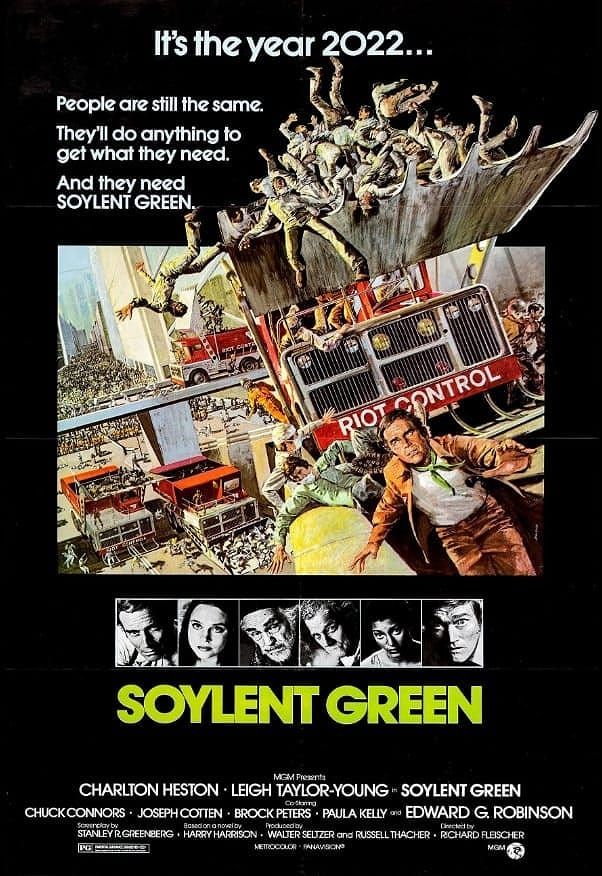
by Patrick Carella
I first saw the film, Soylent Green at fourteen. What frightened me wasn't just the ending. It was the world that made the ending possible: a planet choking on overpopulation and pollution, dying oceans, and a society where only the wealthy could buy clean water, fresh food, or a semblance of a normal life.
Fortunately, that cautionary tale never fully came to pass. At least not yet.
The story takes place in New York City in 2022, a metropolis shrouded in a sickly green-yellow haze. Exhausted people shuffle through the streets in ragged clothes and improvised masks.
But it was the food I couldn’t shake.
Most of the population survives on Soylent. There was Soylent Blue, Soylent Red, and Soylent Yellow, each marketed as an improvement over the last in taste and nutrition. At one point, vendors even hawk discounted "Soylent Crumbs."
Then came Soylent Green, the miracle food. Supposedly made from plankton, it promised better flavor, better nutrition, and hope for a starving world. It was the Soylent Corporation's latest gift to humanity, produced by an industrial machine whose methods bear an uncomfortable resemblance to today's mass-food manufacturers.
The film came out in 1973. I was fourteen. Charlton Heston starred. It was Edward G. Robinson's final performance. The food itself remained an abstraction.
Fast-forward to 2026, four years beyond the future the film imagined. I stumbled across it one night on TCM. I stopped channel surfing. I'll watch Edward G. Robinson in almost anything.
I expected disappointment. Instead, nothing changed. If anything, the film became even sadder, especially Robinson's death scene.
Before Sol Roth (Robinson) chooses euthanasia, Thorn (Heston) manages to obtain something almost mythical: real food. A slab of beef. Lettuce. Tomatoes. Apples. Celery. Butter. Peach preserves. Sol lingers over each bite as though he were tasting memory itself. None of it is extravagant. It's supermarket food. Ordinary food. That's what makes the scene so devastating. In the world of Soylent Green, ordinary has become unattainable.
Movies age in strange ways. Digital restoration lets us see things audiences in 1973 never could: brushstrokes, seams in costumes, fake snow, matte lines, props. Sometimes that destroys the illusion.
In this case, it was the market scene.
Vendors hawking Soylent Red. Soylent Yellow.
The football-helmeted police announce that Soylent Green is sold out for the day. A riot erupts. Riot-control vehicles called Scoops roll in to clear the streets. People are lifted and hauled away like compost. In the chaos, two tumbling bins of Soylent Blue and Soylent Red buns spill into the street along with a few unfortunate policemen.
High-definition reveals something the filmmakers probably never expected anyone to notice.
I froze the frame.
I zoomed in.
The baking separation marks were still visible.
They were no longer dystopian sustenance. They were ordinary supermarket hamburger and hot dog buns sprayed blue and red.
Painted into the future.
Fresh from 1973.
I’d captured a textbook example of not being able to unsee something.
Oddly, my sense of dread only deepened.
It took me a while to understand why. Hamburger and hot dog buns are among the most ordinary, optimistic pieces of American food. Backyard cookouts. Little League. The Fourth of July. Fast food. Childhood.
Now they are tragically vaulted to a foreign place and time, forever waiting to be filled by meat that was never coming.
The filmmakers probably didn't have the budget to fabricate thousands of futuristic rolls. The prop department reached for bread and spray cans instead. Whether they intended it or not, they created the perfect accidental metaphor.
Besides, how do you get dead people to rise?
I still adore the film. I still cry as Edward G. Robinson dies to Grieg’s Åse's Death.
I just can’t look at hamburger and hot dog buns the same way.
Patrick Carella writes fiction and creative nonfiction about family, memory, advertising, obsession, and the strange dignity of American life. He is an MFA candidate at the University of Texas at El Paso. His work has appeared in Wicked Shadow Press, CafeLit, Gorko Gazette, and is forthcoming in BULL, Hobart, The Eunoia Review, Panorana, and The Hooghly Review. He lives in Cornwall-on-Hudson, New York, with his wife and their pit bulls, who remain unimpressed by literary publication.
Subscribe to my newsletter
Subscribe to my newsletter to get the latest updates and news

Member discussion