
Telstar
A Recursion
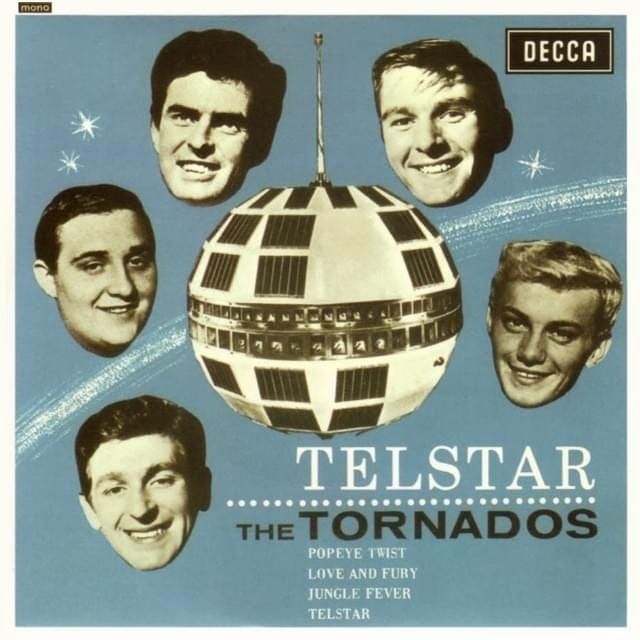
by Patrick Carella
It topped the charts on December 22, 1962—just in time for Christmas.
Low synthetic rumbles and percussive blasts—then a nasally organ climbing in the key of G, note by note, until it sounded like the house itself might lift off its foundation.
They called it Telstar—an instrumental noted for its futuristic, space-age sound. You couldn’t turn on a radio or walk into a diner or gas station without hearing its eerie, rumbling ascent.
The song was inspired by the Telstar satellite, launched that July—a project that enabled the first live transatlantic TV transmission.
It was supposed to sound like a forward leap—a celebration of a new world, suddenly shrunk by satellite, where images could bounce across oceans and continents in real time. And to most people, that’s exactly what it was: a marvel. But even as a child, I felt something else hiding inside it. A sense of longing. A haunted wail that I had no cure for.
The melody, played on a clavioline—a primitive, warbly synthesizer—didn’t soar so much as ache. It climbed, but not with confidence. It teetered. It cried. And beneath it, the chords moved in unsettling ways: a mix of major and minor melancholia, shifting downward when you expected lift. G to F to E minor to D. Like the floor falling out from under you.
There was reverb on everything. Echoes trailing off into black space. You couldn’t tell where the music ended and the silence began.
Everyone else heard the future.
To me, it was the sound of fear, dread, and nightmares.
It became the soundtrack of my father, who was in the VA hospital.
I was three years old.
He was being treated for anxiety disorder and depression, and was pretty drugged up whenever we visited.
At the time, I couldn’t fully understand why the song reminded me of him. It just did—something about a giant cylinder blasting fire and forcing itself off the ground. In a world of doo-wopped, carbureted cars, it felt out of place—loud, unstable, like it didn’t belong—dragging my father with it.
To me, it signaled the monsters were coming.
Not monsters-under-the-bed nightmares. But the kind where everything familiar is slightly off—where someone you love is there, but not really.
I’d hear the song and see his shadow in the hospital corridor, shuffling towards us, eyes vacant, somewhere in space.
He wasn’t dying. But he wasn’t fully alive either.
Out of the house. Out of reach.
Sunny days at the beach were no safer—the tinny bus radio, ambushed by airwaves, landing with a thrust of rockets, straight to the gut. Courtesy of WMCA, home of “The Good Guys,” who played all the hits.
There was no place to hide.
I’d uncover my ears and hear the song.
I’d uncover my eyes and see my father.
A musical betrayal in a 4/4 time signature.
He eventually came home.
The song faded from the charts.
But not from me.
I carried it like static. Like signal.
Later, I’d learn dread had many frequencies—like the one being broadcast from Southeast Asia.
In 1962, it haunted my world—like watching a scratched-up newsreel of a rocket that didn’t come back.
Even now, when I hear it—escaping unannounced through a bleeding-edge sound system—it wrenches something loose.
I’m three again—watching him in that green-walled, fluorescent corridor, both of us unreachable.
The future came, just like the song promised.
But it never brought him all the way back.
It never brought me all the way back either.
Patrick Carella writes fiction and creative nonfiction about family, memory, advertising, obsession, and the strange dignity of American life. He is an MFA candidate at the University of Texas at El Paso. His work has appeared in Wicked Shadow Press, CafeLit, Gorko Gazette, and is forthcoming in BULL, Hobart, The Eunoia Review, Panorana, and The Hooghly Review. He lives in Cornwall-on-Hudson, New York, with his wife and their pit bulls, who remain unimpressed by literary publication.
Subscribe to my newsletter
Subscribe to my newsletter to get the latest updates and news


Member discussion