
The Labyrinth at Sunset
by Grove Koger
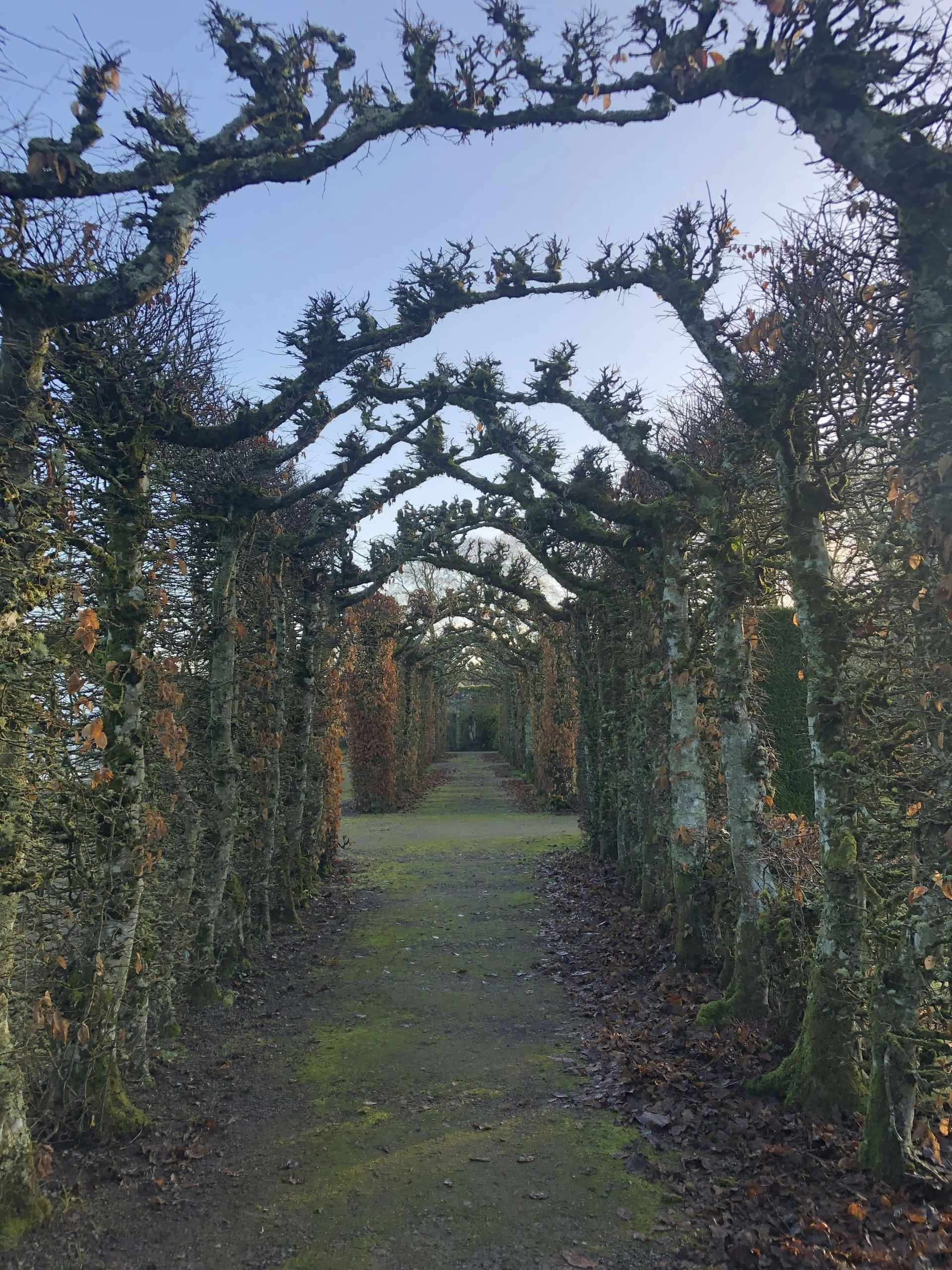
What sticks most in my mind, even now, are the images from Thea’s phone:
The jittery footage slides over the poster beside the door, then we’re inside and things are a bit steadier. She pans the few visitors, gets a big grin from Edmund, and then moves more slowly over the painting itself. (Recently I’ve had those particular images combined and straightened and printed on a big sheet of photographic paper, as big as the studio wall will handle.) And there it is, but frustratingly indistinct: the pale grey foreground, the outer, encircling walls glowing ochre in waning sunlight on the lower right, the tops of half a dozen other walls picked up in the same ochre, while the rest of the structure is in darkness. The labyrinth’s shadow stretches and spreads out to cover the entire upper left portion of the canvas—and then spreads out past the frame itself, where, presumably, the artist or his agent has painted the actual wall, all the way to the corner of the room and, so far as we can see, onto the ceiling. Oh, there are suggestions of the twists and turns, dark grey on black, and of course the indistinct knot of something in the center. Impossible to tell what, but definitely something. The tech people tell me that it’s not a glitch in the image itself.
***
As the Cambridge Dictionary puts it, a labyrinth is “a confusing set of connecting passages or paths in which it is easy to get lost.” But then it can also be “a structure in the inner ear containing the small organs responsible for hearing and balance”—which I didn’t know until I double-checked the definition recently. As it so happens, I have a poor sense of direction … and perhaps I’m slightly lost myself. But Edmund, well, he was definitely lost, had been for quite a time. Was it inevitable that he end up where he did? That I don’t know.
What I did know, within a couple of days, and what everyone else knew by then, was that the remains of fourteen young men and women, Edmund’s among them, had been found in an immense pile of charred hoardings a few miles down the coast at Cala des Verro. And that … the bones had been gnawed.
But it made a kind of sense. And I know that the disappearance of 13 other young men and women that night in Palma made the same kind of sense. And I know because Edmund’s mother begged me to help her learn more, and I did, a little more.
***
After all, I was a friend of Edmund’s family, a good friend since my earliest visit to Mallorca. (And I might well have been Edmund’s father, had circumstances been slightly different.) Plus I had time on my hands at the moment, and I had research skills that, despite being basic, were (I’m pretty sure) beyond the ability of most people, so I had no solid reason to turn her down. And, after a time, it all became an obsession.
The gallery had been a little room on a narrow old side street—Carrer dels Apuntadors— in which the painting had hung, and it was open a few evenings in August. A simple poster beside the door advertised The Labyrinth at Sunset and its equivalent in Catalan—El laberinto al atardecer—and a table in a far corner held glasses of wine for those who might want one. I imagine that those yearning to find a way in would be drawn to the little room and the painting, (and the wine, of course) and would, in every sense, never find their way out. Edmund was one such soul. My report describes my search for the story behind his disappearance and death.
My first efforts involved talking with a clipping service. There didn’t seem to be any on Mallorca or Menorca, which was no surprise, but I located one a phone call away in Barcelona. However, all that the service could provide were reports (and more reports) from the local newspapers, reports that we ourselves had seen. There had, of course, been quite a few disappearances throughout the year, but several were eventually solved, and several others weren’t, at least on the surface, terribly suspicious. People disappear all the time, for all kinds of reasons. Most of them reappear, sooner or later.
But my next step yielded more interesting results, and it was then that I started to understand the wider extent of the situation. The police who interviewed Thea and Edmund’s parents had connected the disappearances to the art show, as several of the other apparent victims had been seen there or near there as well. But they paid no attention to the subject of the show, the singular Labyrinth at Sunset.
At some point, I began to put the clues together.
I had learned long ago (and nearly forgotten), in a class on Greek mythology, about a monster known as the Minotaur and the sacrifices made to it. And although mythology seemed a world away, a universe away, from the world I lived in, I was struck by the images from Thea’s phone, images of Edmund examining the painting. For the Minotaur, you see, had been imprisoned in a labyrinth, and fourteen victims had been sacrificed to it. Young victims.
In all, the Palma police had reports of 19 disappearances that evening, but, one by one, they were accounted for. Within a few days, four of the feared victims returned home. That left 15. In other words, one more than 14. Had one of the victims drowned? Run away with a boyfriend? A girlfriend? But I thought of the Minotaur’s actual victims as being 14 in number.
As you might guess, my attempts to interest the police in the actual painting and the circumstances of its display were useless. I realized what had happened, saw it in my mind’s eye, but the police were blind to it. They lived in a world that didn’t admit such evidence.
***
According to the legend, the labyrinth was built by Daedalus and his son Icarus for Minos, the King of Crete, at the ancient city of Knossos on Crete. The two designed this particular labyrinth to hold the Minotaur, the monstrous offspring of Queen Pasiphae and the Cretan Bull, or Κρὴς ταῦρος. But, of course, such monsters must be fed periodically, must be assuaged.
Was the labyrinth a kind of spiritual trap for those souls who find themselves lost? Some such individuals yearn to find a way, and others yearn to be found. But who, or what, arranges the trap? Or does it simply manifest itself? I felt sure that determining who had rented the space and arranged for the display of the painting would lead to the culprit. But, as it turned out, and as the police themselves discovered, everything had been handled electronically, the money transferred electronically, the painting hung (and the black shadow painted onto the wall) … all were arranged electronically. That much the police were able to determine, and, for all intents and purposes, their inquiries ended there.
***
I’ve always been fascinated by insects, and, as a child, watched wasps making paper nests, and found mud daubers building their own mud versions in the darkness of garages and abandoned buildings. Once I found a tiny jug that had been built by a potter wasp on the stem of a reed growing along a ditch bank. No “wizard” behind the curtain decreed that those wasps do what they did, but the behavior simply manifested itself—a pattern that we call “instinct” without understanding it at all. But something as large as a labyrinth?
It was another Edmund, Edwardian poet Edmund Stone, who wrote about “the feet that tread the dusty paths / Of the labyrinth at sunset,” and so on. Those involved with the labyrinth (at whatever level) must have read those lines at some point. Or … are the lines simply replicating themselves, first in the title of the painting and now, I’ve just realized, in the title of my report? Is the concept of free will an illusion?
***
Assuming that the labyrinth had appeared (or manifested itself) every nine years, I wondered where else such manifestations had taken place. The first, of course, had been in Crete, aeons ago. Would the others all have been someplace in the Mediterranean? Did that make some kind of sense? I had no idea. But I started e-mailing librarians I knew, asking for help about unexplained disappearances. Based on what had just happened in Mallorca, I could pretty much identify key years.
In time, my contacts provided me with some results. They were fragmentary, but, knowing what I felt I knew at that point, they were complete enough. There had been a similar series of disappearances nine years ago near Cassis, on the southern French coast, and another series eighteen years ago at Morar, on the western coast of Scotland, of all places. Searching beyond that point seemed impossible, and, to me at last, pointless. I knew what I knew.
So …
What I knew at this point was that the labyrinth manifests itself every nine years, per the ancient legend, and, perhaps under the aegis of someone or something I’m calling the Master, traps those yearning to be trapped. (Might the Master be Daedalus himself? Or might there have been a master before Daedalus? Might there have been a Master from time immemorial? Or has there been no real Master at all?) There will be fourteen sacrifices, seven young men and seven young women, again according to the legend, and they will be the prey of the Minotaur. They may have dreamed for years of regaining their balance, finding a way out of themselves, and here, finally, is a satisfyingly concrete manifestation of their spiritual state, although it will prove to be, in fact, a one-way path. In any case, their search will be over.
But their loved ones will forever wonder, as Edmund’s sister Thea wonders. She, at least, set off an investigation. Will others? Will there ever be an end to it?
***
As Surrealist painter Max Ernst once remarked, “Every normal human being (and not merely the 'artist') has an inexhaustible store of buried images in his subconscious, it is merely a matter of courage or liberating procedures ... of voyages into the unconscious, to bring pure and unadulterated found objects to light.” Perhaps this labyrinth has been buried in my subconscious since childhood and is only now coming to (partial) light. Perhaps it’s buried in yours as well, and perhaps it was buried in Edmund’s.
The myth is universal, for the lost are everywhere, and are waiting …
And yet, what sticks most in my mind, even now, are the images from Thea’s phone:
The jittery footage slides over the poster beside the door, then we’re inside and things are a bit steadier. She pans the few visitors, gets a big grin from Edmund, and then
Grove Koger is the author of a readers’ guide to travel narratives, When the Going Was Good; a chapbook of poetry, Not; two chapbooks of supernatural fiction, Something Strange and Ancient Afternoons; a collection of supernatural fiction, Treacherous Waters; a collection of experimental fiction, Sun Dogs; and a collection of poetry and realistic fiction, Out of Idaho. He lives in Boise, Idaho, with his wife, poet Margaret Koger.
Subscribe to my newsletter
Subscribe to my newsletter to get the latest updates and news






Member discussion